
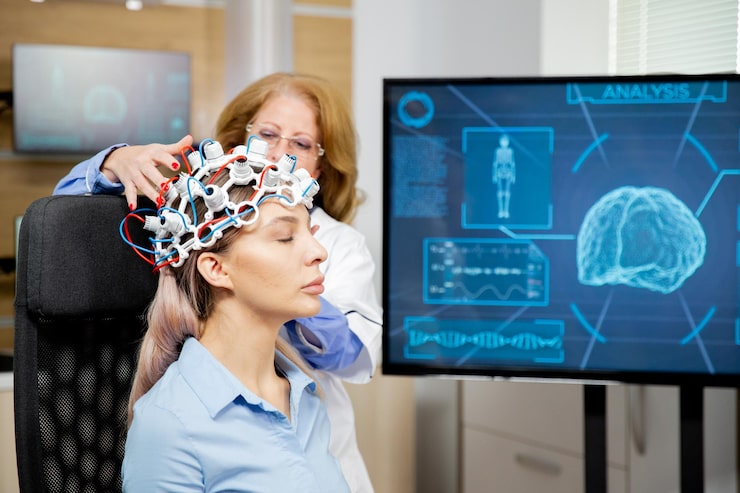
Wearable Brain Tech is no longer a futuristic dream but an emerging reality that’s reshaping how humans interact with machines. Imagine a device that doesn’t just track your heartbeat or sleep cycle, but actually interprets your thoughts, emotions, and focus levels in real time. That’s the transformative promise of neural computing in wearables — where artificial intelligence merges seamlessly with human biology.
Over the past decade, wearables have evolved from simple fitness trackers into intelligent systems capable of understanding the body’s most intricate signals. The next leap forward, powered by Wearable Brain Tech, will take this understanding to the neural level — allowing technology to not just read data, but to learn from it in profoundly human ways.
The Science Behind Wearable Brain Tech
At its core, Wearable Brain Tech integrates neural computing with bio-sensing hardware to process cognitive data directly from the human nervous system. This means the device can analyze brainwave patterns, electrical impulses, and emotional responses, translating them into actionable insights.
Neural computing refers to the use of AI models that mimic the human brain’s neural networks. When embedded in wearable devices, these models can process complex signals from the brain in real time. For instance, a neural wristband could detect stress levels and suggest breathing exercises before the user consciously feels anxious.
This real-time brain-computer interaction opens endless possibilities — from improving mental health and productivity to enabling seamless control of digital systems using nothing but thought patterns.
How Neural Computing Powers Wearable Intelligence
Traditional wearables rely on sensors to capture physical data like heart rate, temperature, or movement. However, Wearable Brain Tech goes several steps further by using neural interfaces that collect cognitive data — such as attention span, mood fluctuations, and mental fatigue.
These devices use miniature electroencephalogram (EEG) sensors embedded within comfortable, everyday wearables like headbands, earbuds, or even glasses. Neural computing algorithms then process this raw data locally, learning the user’s unique cognitive patterns over time.
This personalization makes the technology highly adaptive. For instance, if a neural fitness tracker learns that you perform better workouts with specific music tempos, it can automatically adjust your playlist to optimize performance. Similarly, an AI-driven headset can reduce background noise when it detects cognitive overload, helping the user maintain focus.
In short, neural computing enables wearables to become intuitive companions — capable of understanding, anticipating, and responding to human needs.
Applications of Wearable Brain Tech in Daily Life
The applications of Wearable Brain Tech are already starting to touch multiple aspects of human life, from healthcare to workplace productivity and entertainment.
In healthcare, neural wearables are being developed to assist people with neurological conditions like epilepsy or ADHD. By continuously monitoring brain activity, these devices can predict seizures or attention drops, enabling preventive action. For patients recovering from brain injuries, neurofeedback-based wearables help retrain neural pathways, accelerating rehabilitation.
In the workplace, companies are exploring neural headsets that monitor cognitive load to prevent burnout. Employees receive real-time insights into their focus cycles, allowing them to schedule tasks during optimal mental states.
The entertainment industry is also embracing neural interfaces. Game developers are creating immersive experiences where players can control actions through emotion or concentration. Imagine playing a racing game where your calmness controls your speed — a new dimension of human-computer interaction.
The Role of AI in Advancing Wearable Brain Tech
Artificial intelligence forms the cognitive backbone of Wearable Brain Tech. Unlike traditional systems that rely on pre-programmed instructions, neural AI models continuously learn from each user’s brain activity, becoming smarter with every interaction.
These models can identify subtle cognitive signals that humans themselves may overlook. Over time, AI creates a personalized “neural fingerprint” — a unique map of the user’s mental and emotional states.
This adaptive intelligence is crucial for precision and safety. For example, in mental wellness applications, AI can differentiate between temporary stress and chronic anxiety by recognizing long-term patterns. It can then recommend appropriate actions — like relaxation prompts or focused breathing exercises — without external input.
The integration of edge AI ensures privacy, as data processing occurs directly within the device instead of cloud servers. This not only enhances response speed but also protects sensitive neural data from unauthorized access.
Ethical Dimensions and Data Security Challenges
As promising as Wearable Brain Tech is, it also raises vital ethical and privacy questions. Brainwave data is the most intimate form of personal information — revealing cognitive states, emotional patterns, and even subconscious reactions.
Ensuring this data remains secure is paramount. Tech companies are investing heavily in encrypted neural data storage and anonymized processing models to prevent misuse. Furthermore, transparent data policies are essential to build user trust.
Ethical frameworks must also guide how neural insights are used. While brain-sensing technology can enhance productivity or mental health, it should never be exploited for surveillance or behavioral manipulation. Striking this balance is crucial for sustainable adoption.
To maintain EEAT principles — Expertise, Experience, Authoritativeness, and Trustworthiness — developers and users must understand both the potential and the boundaries of these technologies. Responsible innovation will determine how successfully Wearable Brain Tech integrates into society.
Wearable Brain Tech and Human Performance Enhancement
One of the most exciting frontiers of Wearable Brain Tech lies in performance optimization. Neural wearables can detect when the brain is in a “flow state” — a condition of deep focus where creativity and efficiency peak.
Athletes, musicians, and professionals are already experimenting with neurofeedback devices to train their brains for peak performance. By visualizing real-time neural activity, they learn how to maintain optimal mental states under pressure.
For example, a professional archer might use a neural headset during practice to monitor concentration levels. Over time, they can train their brain to sustain focus for longer periods, improving accuracy and reaction time.
This synergy of human intent and machine intelligence could redefine performance standards across industries.
Integration with Other Emerging Technologies
The evolution of Wearable Brain Tech is closely linked with advancements in other domains like nanotechnology, biosensors, and edge computing.
Nanotech is enabling ultra-thin neural sensors that blend seamlessly with skin or hair, making wearables nearly invisible. Edge computing ensures low-latency data processing, allowing real-time neural responses without cloud dependence.
Additionally, integration with augmented reality (AR) and virtual reality (VR) systems is unlocking new levels of immersion. Imagine AR glasses that detect when you’re overwhelmed and automatically reduce visual clutter — creating a more balanced digital experience.
This cross-technology collaboration is shaping a world where humans and machines don’t just coexist — they cooperate.
The Future of Neural Computing in Everyday Wearables
The next generation of Wearable Brain Tech will move beyond passive monitoring to active augmentation. These devices will not only read neural signals but also enhance brain function through stimulation and adaptive feedback loops.
Neural stimulation techniques like transcranial direct current stimulation (tDCS) are being refined for safe, wearable use. When combined with neural computing, they could boost memory, focus, and creativity in real time.
Imagine wearing an intelligent headset that detects mental fatigue and gently stimulates specific brain regions to restore alertness — all without caffeine or medication. This convergence of neuroscience and AI has the potential to redefine what it means to be human in the digital age.
The ultimate goal is symbiotic intelligence — where humans and machines share information seamlessly, each enhancing the other’s capabilities.
Human-Centered Innovation and EEAT in Wearable Brain Tech
The success of Wearable Brain Tech will depend on how well it upholds human values and scientific credibility. The EEAT framework plays a critical role here.
Developers must demonstrate expertise through rigorous scientific testing, experience through real-world trials, authoritativeness by collaborating with neuroscientists and ethicists, and trustworthiness by ensuring transparency and data security.
This balance of innovation and integrity will define the public’s confidence in neural wearables. As the line between human cognition and digital intelligence blurs, ethical stewardship becomes just as vital as technological brilliance.
Ultimately, Wearable Brain Tech is not about replacing human intelligence — it’s about amplifying it. By learning from our thoughts, emotions, and behaviors, neural computing wearables offer a vision of technology that truly understands us, helping humanity evolve into its next intelligent era.
Read also:
teckjb com
kolkata knight riders vs royal challengers bengaluru match scorecard
clearskinstudy emails addresses
social media girls
noraxidbemosoz
social media girl forum
social media girls forum
