
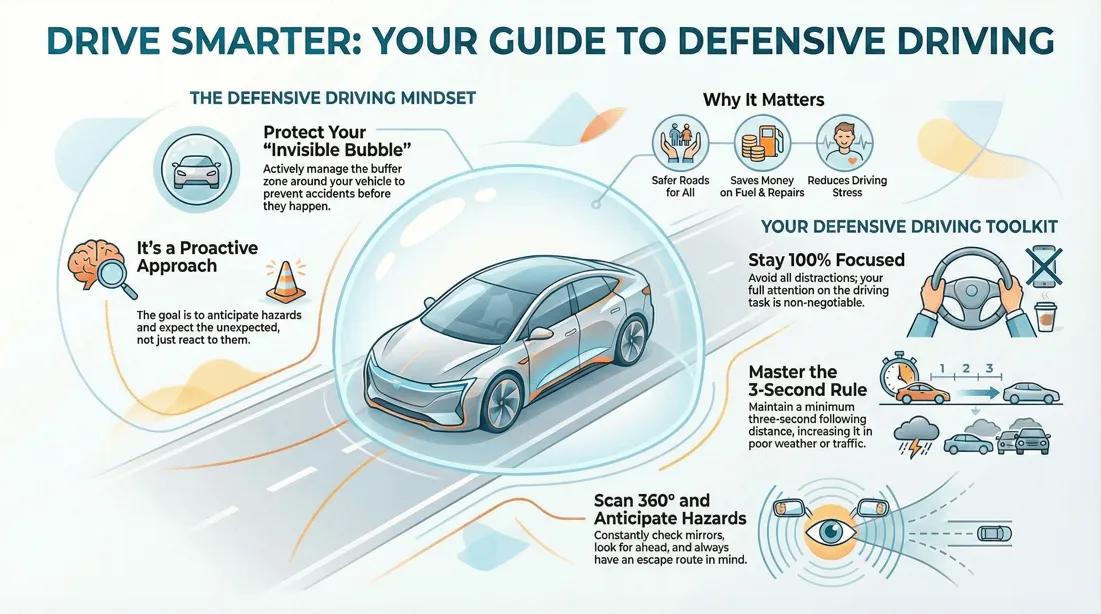
Defensive driving tips are more than just traffic rules; they are habits that can genuinely protect you, your passengers, and everyone sharing the road. Every day, millions of drivers head out assuming they’ll reach their destination safely. Yet accidents often happen in seconds, usually because someone wasn’t prepared for the unexpected.
A few years ago, I witnessed a near collision at a busy intersection. One driver sped through a yellow light while another assumed the road was clear. Luckily, the second driver had slowed down and checked both directions before moving. That single moment of caution prevented what could have been a serious crash.
That’s the power of defensive driving. It’s not about expecting the worst. It’s about being ready for it.
What Are Defensive Driving Tips and Why Do They Matter?
At its core, defensive driving means anticipating potential hazards and making safe decisions before danger becomes unavoidable. It’s a mindset that prioritizes awareness, patience, and responsibility.
Road conditions, distracted drivers, unpredictable pedestrians, and sudden weather changes all create risks. You cannot control other drivers’ behavior, but you can control your reactions.
Practicing Defensive driving tips consistently reduces the likelihood of accidents. Studies from traffic safety authorities show that proactive driving habits significantly lower crash rates and insurance claims.
It’s not just about passing a driving test. It’s about staying safe every single day.
Awareness Is the Foundation of Defensive Driving Tips
The most important principle behind defensive driving is awareness. That means scanning the road ahead, checking mirrors frequently, and observing traffic patterns around you.
Experienced instructors often recommend looking at least 10 to 15 seconds ahead while driving. This gives you time to identify brake lights, merging vehicles, or obstacles before they become emergencies.
Distractions are one of the biggest threats to road safety. Even a quick glance at a phone can delay reaction time significantly. By keeping your focus fully on the road, you dramatically improve your ability to respond safely.
Many certified driving trainers emphasize that consistent application of Defensive driving tips begins with eliminating distractions entirely.
Maintaining Safe Following Distance
Tailgating remains one of the most common causes of rear-end collisions. Maintaining a safe following distance provides essential reaction time.
The widely recommended three-second rule works well under normal conditions. In poor weather, increasing that gap to four or five seconds adds an extra layer of safety.
Imagine driving on a highway when the vehicle ahead suddenly brakes. Without sufficient space, even quick reflexes may not prevent a collision.
Creating space is not a sign of weakness. It’s a sign of intelligent driving.
Speed Control and Road Conditions
Speeding doesn’t just increase the likelihood of accidents; it intensifies their severity.
Defensive drivers adjust speed based on traffic flow, weather, and visibility. Wet roads, fog, and nighttime driving demand extra caution. Even if the speed limit allows faster travel, conditions may require slower movement.
Applying Defensive driving tips means understanding that speed limits represent maximums under ideal conditions, not guarantees of safety.
Slowing down gives you more time to react and reduces stopping distance significantly.
Defensive Driving Tips for Urban Traffic
City driving presents unique challenges.
Intersections, pedestrians, cyclists, and frequent lane changes require heightened alertness. Many accidents occur at traffic lights where drivers assume others will obey signals.
Approaching intersections with caution, even when you have the right of way, can prevent collisions caused by red-light runners.
Urban defensive driving also involves watching for pedestrians stepping off curbs unexpectedly. Anticipating these behaviors gives you valuable reaction time.
In crowded environments, applying Defensive driving tips becomes even more critical.
Handling Aggressive Drivers Calmly
Road rage and aggressive behavior are unfortunate realities.
When confronted with an aggressive driver, the safest response is not retaliation. Avoid eye contact, maintain distance, and allow them to pass if necessary.
Engaging emotionally increases risk. Defensive driving encourages calm, controlled responses rather than impulsive reactions.
I once drove behind someone weaving aggressively through traffic. Instead of matching their speed or blocking them, I slowed slightly and gave them space. Minutes later, I saw them pulled over by traffic police. Staying calm kept me out of danger.
Practicing Defensive driving tips includes emotional discipline as much as technical skill.
Weather-Specific Defensive Driving Tips
Weather can change road dynamics dramatically.
Rain reduces tire traction and increases stopping distance. Snow and ice create even more hazardous conditions. Fog limits visibility, demanding slower speeds and increased following distance.
Switching on headlights during low visibility enhances your visibility to others. Smooth steering and gradual braking prevent skidding.
Experienced driving instructors consistently stress that adjusting behavior to weather conditions is a core part of responsible driving.
Defensive Driving Tips for Highway Safety
Highways often give a false sense of security due to smoother traffic flow.
However, higher speeds mean reduced reaction time. Merging lanes require careful monitoring of blind spots. Signal early and check mirrors thoroughly before changing lanes.
Avoid lingering in other vehicles’ blind spots, especially near large trucks. Commercial vehicles have extended blind areas, and their stopping distances are much longer.
Highway driving demands anticipation. Watching traffic several vehicles ahead can help predict sudden slowdowns.
Regularly applying Defensive driving tips on highways significantly lowers accident risk.
The Importance of Vehicle Maintenance
Defensive driving extends beyond behavior. Vehicle condition plays a crucial role in safety.
Worn brakes, underinflated tires, and malfunctioning lights increase accident risk. Routine inspections ensure your vehicle responds properly when you need it most.
Professional mechanics emphasize that preventive maintenance supports defensive driving strategies. A well-maintained car improves braking efficiency and stability.
Combining responsible vehicle care with smart driving habits creates a comprehensive safety approach.
Defensive Driving Tips for New Drivers
New drivers often feel overwhelmed by traffic complexity.
Building defensive habits early fosters long-term safety. Practicing hazard recognition, maintaining safe distances, and avoiding distractions form a strong foundation.
Driving schools frequently incorporate Defensive driving tips into their curriculum because research shows that early habit formation reduces long-term accident rates.
Parents and mentors also play a vital role by modeling responsible driving behavior.
Technology and Modern Defensive Driving
Modern vehicles now include driver-assistance systems such as automatic emergency braking and lane departure warnings.
While these technologies enhance safety, they should not replace attentive driving. Defensive driving means remaining actively engaged rather than relying solely on automation.
Understanding your vehicle’s safety features and limitations strengthens your overall safety strategy.
Technology works best when combined with human awareness and sound judgment.
Psychological Aspects of Defensive Driving Tips
Driving is as much psychological as mechanical.
Stress, fatigue, and emotional distress impair judgment and reaction time. Defensive drivers recognize when they are not in optimal condition to drive safely.
Taking breaks during long trips, avoiding driving when overly tired, and managing stress contribute significantly to road safety.
Applying Defensive driving tips includes self-awareness. Knowing when to pause can prevent avoidable accidents.
Legal and Insurance Benefits
Many insurance companies offer discounts for completing defensive driving courses.
Certified programs teach hazard recognition, safe following distances, and emergency maneuvering techniques. These courses reinforce essential safety principles and demonstrate commitment to responsible driving.
Traffic authorities also encourage defensive driving education as a preventive strategy to reduce accident statistics.
Adopting these practices can lead to both financial and safety advantages.
Building Lifelong Defensive Driving Habits
Habits form through repetition.
Practicing mirror checks, scanning ahead, maintaining distance, and adjusting speed should become automatic behaviors. Over time, these actions require less conscious effort but deliver consistent safety benefits.
Experienced drivers often say that defensive driving becomes second nature once ingrained.
The key is consistency. Applying Defensive driving tips daily transforms cautious driving into instinctive driving.
Real-Life Impact of Defensive Driving Tips
Every safe journey tells a story of prevention.
Most drivers never realize how many potential accidents they avoid simply by staying alert and cautious. Slowing slightly before a curve, checking blind spots twice, or anticipating sudden braking may seem minor.
Yet these small decisions collectively prevent serious outcomes.
Road safety experts consistently affirm that proactive driving habits reduce crash severity and frequency. Defensive driving is not about fear. It is about preparation, responsibility, and awareness.
In a world where road conditions and driver behaviors remain unpredictable, smart habits provide control. Each time you drive defensively, you actively reduce risk for yourself and others.
Driving is a privilege and a responsibility. The choices you make behind the wheel affect more than just your schedule. They influence lives.
Read also :-
